New Technology You Go to 3d Print Stuff in Health You Get to Learn How Babies Are Made
Latest 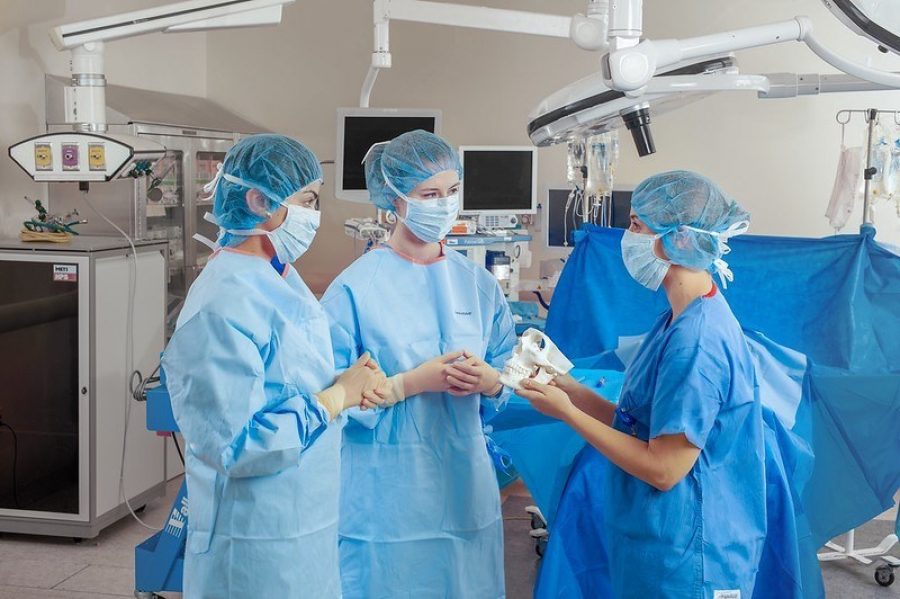
The Ultimate Beginner's Guide to 3D Printing in Healthcare
The globe of 'medical 3D press' or '3D printing in healthcare' every bit it'south also known is fast becoming the largest application in the 3D press sphere. This post, The Ultimate Beginner's Guide to 3D Printing in Healthcare, volition give those in the early stages of investigating medical 3D printing an overview of the topic, and will likewise support individuals who want to augment their agreement of the multifaceted world of medical 3D printing in healthcare. This combines fundamental information from a range of industry sources and links to informative and interesting reading.
What is 3D Printing?
3D printing (also referred to equally additive manufacturing) is the method of creating physical objects from a digital file by adding multiple layers of a fabric, or multiple materials to build a single structure. The construction is based on the input of a calculator-aided pattern file, in a format compatible with the 3D printing hardware. The engineering science's origins can exist traced back to every bit early on as 1983 when it was first invented by Chuck Hull, co-founder of 3D Systems. Since then this concept has evolved to include 15 methods or technologies of combining these layers, all commonly referred to every bit 3D printing.
What is 3D Press in Healthcare?
3D printing is particularly suited to the medical manufacture due to the enquiry-based, innovative and fast-moving nature of the field.
The employ of 3D printing in medicine has been publicized since the early 1990s and in recent years, at that place has been a huge rising in the number of applications emerging in the field as a result of the technology becoming more accessible to users.
With major growth in precision and personalized medicine, there is a strong demand for bespoke and patient-specific medical applications, tailored exactly to an individual or their anatomy.
3D press oftentimes wholly or partially drives production of these custom-made products and devices
Examples of actual and potential uses of 3D printing in medicine include:
- Customized prosthetics and implants
- Anatomical models for surgical planning and education
- Pharmaceutical research including drug dosage forms and discovery
- Tissue and organ fabrication
- Personalized medical products and equipment

The Market for 3D Printing in Healthcare
3D press offers ample opportunities in the healthcare manufacture and as such, the market for 3D printing in the healthcare industry is growing rapidly.
Marketplace research published by Inquiry and Markets predicts the year-on-year growth of 3D printing volition exist in double digits due to the high need from Northward America and Europe, coupled with the rising in sensation almost these devices in developing countries.
With an estimated market value of around $500 million in 2014, there has been a growing torso of industry reporting on the 3D printing in the healthcare market, with 10-year predictions ranging from $2.4 billion to $17.4 billion co-ordinate to Frost and Sullivan's latest marketplace study.
The healthcare sector is expected to be the fastest growing segment of the 3D printing marketplace equally innovations are integrated into specialisms such as orthopedics and implants.
Regulatory Requirements of 3D Printing in Healthcare
Every bit in that location are continual advancements within 3D printing, regulatory requirements change at a rapid pace.
Some organizations exist to advise on regulation, beyond simply the telescopic of 3D press, to assist in technical standardizing and assist product rubber and quality including the earth-leading International Standards Organisation (ISO).
Specifically for 3D Printing (Additive Manufacturing Standards), the ISO and ASTM International (The American Gild for Testing and Materials) have collaborated together and developed the Condiment Manufacturing Development Structure (AMDS), that volition aim to provide technical standards across the board.
Additionally, the FDA recently released "leapfrog guidance" on its initial thinking and recommendations for Technical Considerations for Condiment Manufactured Medical Devices.
This guidance outlines that manufacturers should also appoint with the Center for Devices and Radiological Health (CDRH) or CBER through the Pre-Submission procedure to obtain more than detailed feedback for Additively Manufactured medical devices.
The FDA defines a medical device equally "an instrument, apparatus, implement, machine, contrivance, implant, in vitro reagent, or other similar or related article, including a component role, or accessory which is: "… intended for utilize in the diagnosis of illness or other conditions, or in the cure, mitigation, treatment, or prevention of disease"
Information technology could be considered that 3D printed anatomical models used for preoperative planning, might not warrant regulation by FDA if they are not intended for employ in any purposes aforementioned.
How is 3D printing used in healthcare?
The main uses for 3D printing in healthcare currently are:
Patient-specific anatomical models for preoperative planning
Medical imaging using 2D or 3D onscreen engineering provide limitations when radiologists and surgeons are visualizing complex pathologies and abnormalities.
Increasing, both radiology teams and surgeons are using 3D press to create 3D 1:1 models of anatomical areas, replicated exactly from patients' scans, which can be held in-manus and used for preoperative cut, planning, and collaborative team working.
These anatomical models are often used in patient advice and consultation to show and explain to patients about their medical weather and what their surgical procedures volition involve.
They also have use in surgical education, providing medical students and inferior doctors the opportunity to exactly meet tumors, fractures, lesions, and other abnormalities.

How 3D printed anatomical models are produced
In brusque, the process of creating patient-specific anatomical models is the conversion of two-dimensional medical images to a 3-dimensional file that tin can be utilized in 3D printing.
The process begins by utilizing raw medical images usually in DICOM® format (Digital Imaging and Communications in Medicine) typically CT, MRI, PET, SPECT.
The images stand for a ii-dimensional cross-department of the patient's anatomy, typically taken in the axial airplane (XY dimensions depicting left to right and front to back aspects of the patient).
The centric slices are 'stacked' in processing software to grade a volumetric dataset with the space between the scans representing the inter voxel space of the final 3D model (z dimensions, depicting pinnacle to bottom of patient). As a general rule, the larger the space betwixt the scans the lower the resolution of the final 3D model that will be produced.
Once data has been stacked within the software, a procedure of segmentation (also referred as contouring) is carried out on each centric slice to delineate the portions of anatomy which will be 3D printed or non.
This process is typically washed with a number of segmentation tools, both manual and semi-automated, to annotate each image pixel in the dataset.
Once all data is segmented, a volumetric surface of the two-dimensional annotations are created and exported in a three-dimensional format (of which the near common are .STL & .OBJ)
Depending on the requirements of the final 3D print, this data tin then be farther processed (pre-processing of the 3D file) by adding in additional features such as pillars to hold anatomy in situ or separating files and coloring for visualization purposes.
In one case the pre-processing has been completed based on model requirements, it is and so inputted into a processing software specifically suited to specific printing technology.
This software (usually supplied with a 3D printer) can be used to add support materials (if the print technology requires it) and converted back into ii-dimensional cantankerous-sections called Thousand-code. This G-lawmaking file volition guide the printer's system to print consecutive private layers to create your patient-specific model.
Teaching & Training
There is an increasing body of research on the benefits of using 3D printed anatomic models in an educational setting.
One of the primal differences in using 3D models versus standard anatomical models is the ability to 3D print specific anatomical pathologies leading to more realistic learning.
In contrast to learning through the use of cadaver material, 3D printed anatomic regions besides ensure each trainee is using the aforementioned pathology during instruction, therefore, standardizing the learning.
Here there is a range of studies looking at the impact of 3D printing as teaching aids:
From medical imaging information to 3D printed anatomical models. Department of Medical Physics and Biomedical Engineering, University College London, United Kingdom
3D printing materials and their use in medical didactics: a review of electric current engineering and trends for the futurity. Section of Mechanical Engineering science, McGill Academy, Montreal, Québec, Canada
Visualization of Cardiac Anatomy: New Approaches for Medical Education, Marian University College of Osteopathic Medicine, Indianapolis, IN, USA
Easily-on surgical training of congenital eye surgery using iii-dimensional impress models, Infirmary for Ill Children, University of Toronto, Toronto, Ontario, Canada
3D Custom implants
Models of the patient's anatomy can be used to support making a standard implant custom, e.grand. bending plates, sizing stents. Custom implants, as well known as 'patient-specific implants' or PSIs are used by surgeons in circuitous cases where a standard implant is not advisable for the instance. These implants are designed and made for an individual patient, tailored to their beefcake and surgical needs.
The advent of 3D printing has enabled these custom implants to be created more than quickly and reduce the price. Read one of a number of papers reviewing the utilise of custom implants

Medical device prototyping
Used for many years in manufacturing, 3D printing is currently revolutionizing medical device prototyping.
At present, small-scale and large companies alike tin chop-chop blueprint, test and engineer multiple device prototypes in days or weeks rather than months/years.
The power for a product designer to see their concrete design in hours rather than months has increased the rate of testing, adapting and fine-tuning the nearly effective functions.
This reduced evolution lifecycle of devices reduces the overall cost, increases the number of test periods, leading to iterative improvements and increased device rubber, and ultimately gives the visitor a competitive advantage.
When a blueprint has been finalized — depending on the expectation for future product adaption requirements, tooling can be traditionally manufactured or tin be 3D printed.
Custom devices & prosthetics
Over a lifetime, the man body is subject to a huge amount of wearable and tear, whether this is a natural occurrence through aging or disease or brought on by an external force (such every bit a traumatic collision). At some time in our lives, the bulk of us will require a custom device to aid us regain our normal functions.
I of the virtually common uses for custom devices is in the creation of individual prosthetics used to supplant limbs. In the United states alone, there are over two 1000000 amputees that all require custom prosthetics.
This matched with the growing availability of 3D printing has sprouted a number of companies and not-profit organizations, making use of 3D printing to produce parts to improve people's standard of life.
One of primeval was the e-NABLE Community made of a network of volunteers beyond the globe all devoting time and engineering resource to create complimentary 3D printed prosthetics.
This "lower cost approach to a highly valued item" ethos has made its mode into a number of commercial entities, with Handsmith & Open up Bionics both adding bionic capabilities to their custom devices.
How are they made?
3D printing's office in prosthetics & custom devices is commonly at the interface between the homo torso and the device itself when grade and fit are required to exist perfect to make a comfy device.
Usually, traditional manufacturing techniques and materials are used to produce the other structural portions of the devices.
Typically in creating custom devices, light amplification by stimulated emission of radiation scanning is carried out on the patient to create a 3D digital surface representation of the anatomy.
This enables the device manufacturers to create straight 'negatives' of the patient'southward beefcake which tin exist 3D printed in a number of different materials directly, which would otherwise be created from traditional cumbersome techniques such as plaster casting.
When considering what printing engineering science and what materials to use for prosthetics design and manufacture there are three chief considerations that should exist taken into business relationship
Mechanical properties of materials
Custom devices get through a number of farthermost forces during twenty-four hour period to solar day wear and advisable mechanical properties should be taken into account for this. Nylon-based materials and tough polymers are commonly used.
Biocompatibility of materials
If the device makes direct contact with the skin for prolonged periods of time ensure that the materials used are biocompatible or bio-inert
3D Printer accuracy
Perfect fit for a patient ways a more comfortable device and an improved standard of life. Finely detailed anatomy such as maxillofacial reconstruction should use equally high an accuracy as possible when choosing applied science, for parts with larger tolerances, similar prosthetic cups, a slightly lower accuracy may be suitable.

Setting up an in-house print lab for 3D printing in healthcare
In his article entitled Considerations for Implementing a 3D Press Cadre Service in Your Infirmary: A Technical Analysis on 3DHeals.com, Todd Pietila outlines the benefits "By bringing the technology in firm, it supports a reduction in 3D printing pb times compared to outsourcing methods, and helps to build noesis and bulldoze innovation inside the hospital."
However, a big claiming is technical expertise and implementation of the innovation in clinical workflows. Choosing a engineering science that is right for your clinic tin be difficult.
With the wide range of technologies on the market place, all take pros and cons. When deciding what technology to chose, for either in business firm printing or when outsourcing these, considerations include but are non express to: material selection, accurateness, cost of auto & materials, maintenance requirements & mail-processing requirements.
- How will 3D press be funded? Charitable donation, fundraising, sponsorship, educational.
- Internal skills sets & personnel Volition new hires be required?
- Internal communications & interest How will surgeons request models, what teams will be involved?
- 3D Printing Workflow software Consider toll and if a single or multiple software solution is required.
- Prototype processing & division Medical imaging can present some complex challenges in terms of automated segmentation.
- Model production 3D print post production requirements can include model grooming, cleaning, and smoothing.
3D Printing Hardware Technologies
Choosing a applied science that is correct for your clinic tin be difficult. With the wide range of technologies on the marketplace, all accept pros and cons. When deciding what technology to chose, for either in business firm printing or when outsourcing these, considerations include only are non express to: material pick, accuracy, cost of automobile & materials, maintenance requirements & mail-processing requirements.
When deciding upon a 3D printer for medical models, ascertain first what the model volition be used for as this determines the blazon of printer required — SLA, SLS, FDM, etc.
For example: Surgical Educational, Visualization, Pre-operative planning, Drilling and Cutting.
The intended utilise of the 3D printed product determines what material should exist used.
PLA & ABS is depression-toll cloth, skillful for visualizing and good for rapid prototyping.
Photopolymer resin is suitable for visualization, cutting and drilling. It is highly effective for combining dissimilar colors and tin can print to 25 microns. Materials can be bio-compatible.
Also, materials are available in clear through to blackness and come in a variety of Shore A hardness.
Gypsum sand is great for creating a visual model in many colors (not including articulate). The material can only exist used for visual representation as the resulting model is very frail and will break nether pressure
Nylon provides high force and stiffness and is a neat fabric for prototypes and manufacturing, Material is bio-compatible and is more suitable for 3D printing complex parts.
3Dcreationlab has further advice on choosing the correct materials.

Vat Photopolymerization (SLA, DLP, CDLP)
Vendors include 3D Systems, Formlabs, Envisiontec & Carbon. The get-go of the technologies to be introduced to the marketplace and still regarded as 1 of the industry standards for both its accuracy and cloth capabilities.
The 2 well-nigh common types are Stereolithography (SLA) & Digital Light Processing (DLP). Both utilize liquid resins as a build material which are placed into a build tank, usually with a clear windowed bottom.
A build platform is and then submerged and a light source is introduced, tracing specific patterns, solidifying a single layer at a time, mapped to the pattern of the concluding object
For each consecutive layer, the build platform will raise by a small-scale increment, allowing additional resin to be introduced and solidified. This process is repeated until the concluding object is complete.
SLA & DLP printers are ideal for printing objects that require a high level of particular and an aesthetic surface finish. This makes them platonic for use in creating intricate medical devices such as hearing aids also every bit creating highly detailed anatomical models for preoperative planning.

Fabric Extrusion (FDM)
Vendors include: Stratasys, Ultimaker, Makerbot & Markforged. FDM (fused deposition modeling) was the start mainstream desktop technology introduced to the market and as a upshot, is ane of the about widely used technologies today.
The applied science uses a solid spool of plastic material (typically PLA or ABS) which is uncoiled during the printing process into a heated printer nozzle.
The technology uses a solid spool of plastic material (typically PLA or ABS) which is uncoiled during the printing procedure into a heated printer nozzle to make it molten.
The nozzle continually extrudes molten plastic onto a apartment build platform post-obit a pre-defined path on its XY centrality to effectively describe i layer of material at a time matching the CAD model uploaded to the printer.
Due to the relatively low cost of the engineering and materials, it has opened the technology up to be used in a broad variety of applications.
Within the medical field, FDM is a good choice when making larger, less complex geometries such as prosthetic fairings & lightweight splints.

Powder Bed Fusion (SLS, SLM/DMLS, EBM, Multi Jet Fusion)
Vendors include: EOS, 3D Systems, Formlabs & Renishaw. The procedure of powder bed fusion is virtually common in prototyping engineering science fields such as automotive or aeronautical.
This is due to the superior mechanical properties of the parts which come straight from the printer, which can be used for functional simulation testing.
The process of SLS (selective laser sintering) works past heating a bed of powdered cloth (typically Nylon or PEEK materials) to just below its melting point.
A light amplification by stimulated emission of radiation is then drawn over the surface of the cloth in a cantankerous-section, matching that of the 3D model uploaded to the organisation. This laser 'sinters' a fine layer of pulverization while leaving all other material effectually it still in powder grade.
Subsequently each layer is sintered, the bed lowers and a roller passes across the top of the bed to eolith a fine layer of additional pulverization before the sintering process is repeated until a finished part emerges.
One of the engineering science'due south main benefits, aside from its superior mechanical backdrop, is that supports are not required when using the engineering science. This is because unsintered powder inside the bed doubles as support material during the print process which can be hands removed and recycled for additional prints.
SLS is mainly used within the industrial technology space because of the relative size, power requirements and price of equipment. Notwithstanding, much lower cost and office friendly versions of the technology have been emerging recently assuasive the technology to be integrated into many other applications.
SLS is a keen selection when considering applications where mechanical properties of parts are paramount.
This makes it ideal for uses in medicine when parts are being bailiwick to daily mechanical strain such as lightweight cast blueprint & scoliosis braces and prosthetic applications.

Binder Jetting
Vendors include: 3D Systems,Voxeljet & ExOne. Binder jetting is the process of dispensing a binding amanuensis onto a powder bed to build a part, one layer at a fourth dimension. These layers demark to one another to class a solid component.
Solid parts are created from a bed of powdered cloth past bounden them together with an adhesive or reagent.
Binder jetting is like SLS technologies as it comprises a bed of powdered material, However instead of a laser sintering each layer, particles are bound together using fabric that is sprayed over the height of the impress bed.
Once the binder is deposited, matching a cross section of the CAD file, a new layer of material is deposited on with a roller system and the procedure is repeated until there is a fully formed part.
The well-nigh common fabric for this engineering science is gypsum powder. However larger industrial machines can also industry parts in glass or metal powders using the same technique. When using the mutual gypsum powder, the binding agent can be integrated within a conventional inkjet printer head to eolith colored fabric to make fully colored finished parts.
Binder jet printing is great for full-color display parts where mechanic functionality and material backdrop are not required.
This makes information technology ideal for applications in colored prototype modeling or in anatomical models when a number of detailed anatomical structures have to be delineated from one another — such as cardiac modeling.
Software used for 3D printing in healthcare
The preparation, storage, and design of 3D printed artifacts in the medical space is driven by dissimilar types of software. The PACS system is at the heart of the process looking later on the storage of the images that are ultimately used to generate models.
Medical images are typically captured in 2nd "slices". These must be converted into a 3D model. The 3D model tin and so be prepared for printing. There are a number of unique concerns at this phase that split 3D printing from other applications such as visualization and VR/AR.
Many software packages exist to allow medical professionals to identify the required beefcake in a set of images. The aim of this stage is to identify the boundaries of the anatomy that is required to be printed from the rest of the images.
Once the images have been segmented the book labeled every bit the required volume is converted into a 3D mesh. A mesh is the 3D surface of the volume. This mesh is now gear up to be candy in preparation for press. A number of technical issues can occur at this stage that prevents printing. 3D design software is typically used at this phase to identify and rectify these bug.
They involve the application of many geometric algorithms to ready the mesh and make it printable.
Data direction and security are of import considerations for all healthcare practitioners. At this stage, it is important to consider how to integrate the request for the creation of a 3D print with the existing workflow of the practitioner.
Many systems still work on manual requests for initiation, therefore care needs to exist taken when managing multiple requests. Some kind of storage arrangement to manage inbound requests and manage load is necessary.
Data minimization is 1 technique to ensure just the required corporeality of data is passed from the PACS system to the 3D press laboratory for execution of the request.
Stages:
- PACS integration/management
- Image segmentation
- DICOM convert volume to mesh
- Post-Processing — fixing volume
- Prep for printing
- Print Direction
- Information Direction
- Quality Control
- Assurance

Physical Location
It is of import to have a dedicated print room that is maintained and kept clean.
A minimum infinite required for a desktop printer and processing station is 3-meter x 2-meter infinite, with suitable ventilation.
For larger printers, a space of 5x4 meters would be suitable for one printer and processing station with suitable ventilation.
When including more printers, the required space volition non multiply per meters higher up. In near cases, added infinite required is one x 2 meters per printer. For more guidance on managing multiple printers, come across advice from Formlabs.
Proceed the print room clean. Every surface should exist suitable to wipe clean and a lint/grit free environment should be maintained. This helps to continue the printers in optimum working order.
Each printer has specific Personal Protective Equipment (PPE) requirements. However, as standard every print room should take the following:
- Protective eyewear including UV safety eyewear
- Protective latex free gloves
- Eyewash station
- Protective article of clothing for article of clothing — this could be disposable aprons, lab coats, and sleeve protectors
3D printer ownership in a hospital or healthcare institution
How the 3D printer will be (or is being used) volition assist make up one's mind buying.
Within a manufacturing environment, engineers would exist best suited to the role. Similarly, for medical imaging model creation, Biomedical engineers/scientists or persons with an beefcake background should exist considered.
Within hospital environments, prosthetics and maxillofacial departments are oftentimes early adopters to 3D press trials and experiments as the technology lends itself finer to these specialisms.
Radiologists may lead 3D press as historically, the radiology department bridges noesis from medical imaging to physicians.
When deciding upon ownership, consider if multiple departments will share the resource; the process by which 3D printing work would exist requested and produced within hospitals; budgets required and how the operation would grow in the hereafter.
3D printed models give insights beyond those you'll find with traditional 2d imaging…
Don't just have our word for it. Try Axial3D today. Find out if you're eligible for a gratuitous personalized 3D printed model of your next patient case here.
Featured image provided by Formlabs.
Source: https://axial3d.com/latest/beginners-guide-to-medical-3d-printing
0 Response to "New Technology You Go to 3d Print Stuff in Health You Get to Learn How Babies Are Made"
Post a Comment